Indo Eden builds metabolic infrastructure for the world’s food supply.
The living base that turns sunlight, rainfall and soil into food is the oldest infrastructure on earth. It is also the only infrastructure the world is letting depreciate to zero, with no programme anywhere to replace it.
The world’s food base has harvests, and no successors.
Much of the world’s food is grown by indigenous smallholders, on land that is one generation from losing the people who farm it. The trees are ageing out, the growers are ageing out, and almost nothing is being planted to replace either.
A harvest is an event. A producing system with a successor is an asset. The crisis is the distance between the two, and it widens every season the old trees are left standing because no one can afford to replace them.
Indigenous Eden.
The restoration of indigenous smallholder farming as productive, sovereign, scalable infrastructure.
This is production, not conservation, charity or heritage. The people who feed the world already exist. They already hold the land and already know how to farm it. Nothing needs inventing. It needs capitalising, systematising and making inheritable.
Eden does not mean untouched wilderness. It means abundance under cultivation: a garden that is tended, inherited and productive, and that gives more the longer it is properly held.
Four hundred years ago the Dutch East India Company bought nutmeg from a handful of islands in the Indonesian archipelago. The people farming those groves today descend from the people who sold to the Company, and the trees descend from those trees. Four centuries of the most aggressive commodity extraction in recorded history never consolidated the land.
What survived is the oldest continuously operating smallholder production system on earth.
By that measure the archipelago is among the wealthiest places on the planet, and by the market’s measure among the poorest. Indo Eden converts the first into the second without destroying the first. Every earlier attempt ran that operation backwards.
Seven positions. Everything Indo Eden does is downstream of them.
Food security is national security. A nation that cannot produce its own food is not sovereign, and a company with no control of its production and no continuity plan is not investable on any horizon that matters. This is the largest infrastructure build of the century. People live without most things. Nobody lives without food.
Ten hectares. One village. A closed loop.
The unit is a Fraktal: ten hectares, inside one village, small enough for one team to walk in a day. It is planted with the people who already hold the land, and it can be onboarded remotely, anywhere the land and the people exist.
Every Fraktal is a closed metabolic loop rather than an extraction site. Its output is food, and the by-product of producing that food is more capacity to produce it.
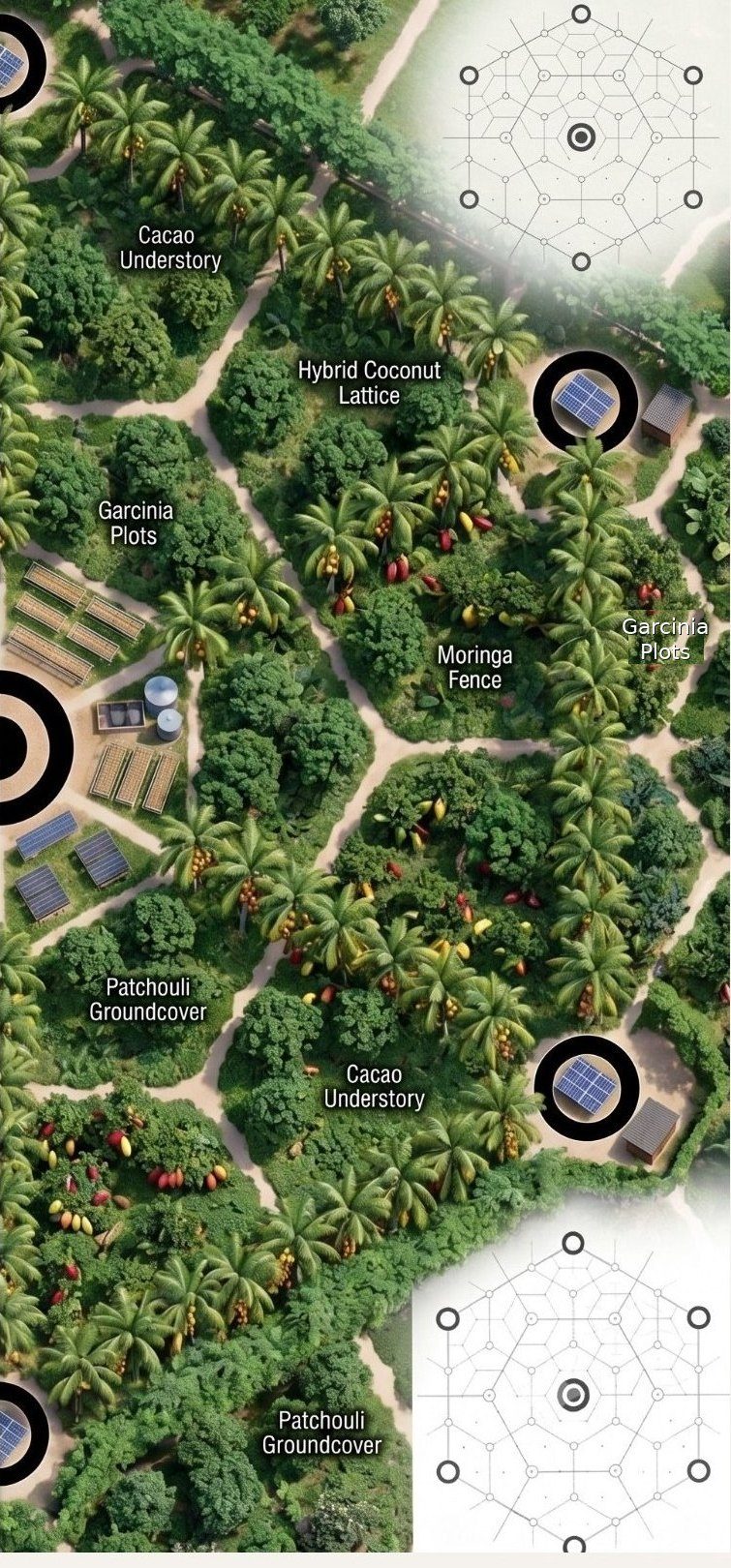
The crop is a variable.
The Fraktal is the container. The crop is specified by whoever buys the output, and matched to the ground that grows its best expression, from sea level to fifteen hundred metres.
Money does not grow on trees. Wealth does.
Matthew Ross, founder of Indo Eden, on the living asset the market prices at almost nothing, and what happens when its value stays where it grows.
Watch the talk Read the reader’s edition (PDF)The standard is written. The ground proof comes next.
Four doors. One thesis.
Indo Eden is the only counterparty that can contract to deliver a specified crop, at a specified volume, for twenty-five years, because it is the only one building the production base that will still exist to deliver it.