Coconut is the proof, not the business.
It is the first foundational crop because no other single tree carries as much optionality: water, oil, sugar, fibre, shell and trunk from one organism. It proves the model on the hardest case, and it is where the failure of supply is most measurable.

The coconut supply is ageing faster than it is replaced.
Indonesia, the Philippines and India produced about 45 of the world’s 62 million tonnes in 2022.
A new palm bears nothing for four years. A family on two hectares cannot wait that long, so the old palms stay and bear less each season.
Coconut oil hit an all-time high of $2,841 a tonne in July 2025. The industry’s own body expects supply to stay below historical norms, because the palms that set the price have not been replaced.
The risk is no longer the price. It is whether the nut exists.
Aggregation worked while the palms were young: buy from thousands of smallholders and the volume arrives. Those palms are now old, the young are leaving the land, and the pool that aggregation draws from shrinks every year. No trading contract can buy back a tree that was never planted.
Each hectare is rebuilt as a canopy, not a single crop.
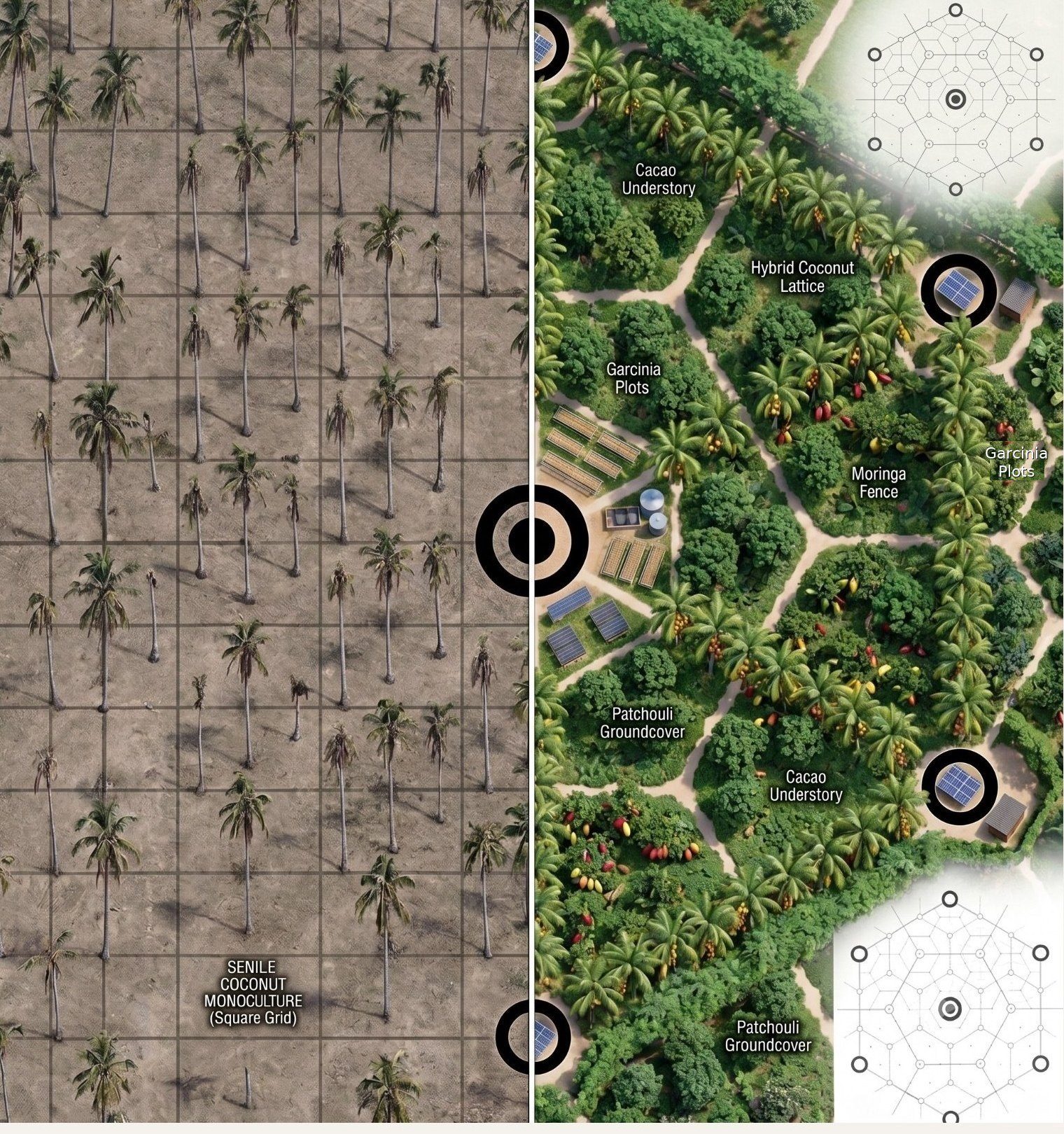
On the left, the land as it stands: senile palms in a bare grid, most no longer bearing. On the right, the same ground rebuilt: new hybrid palms with cacao, moringa, spices, stingless bees and aromatic oils growing beneath them.
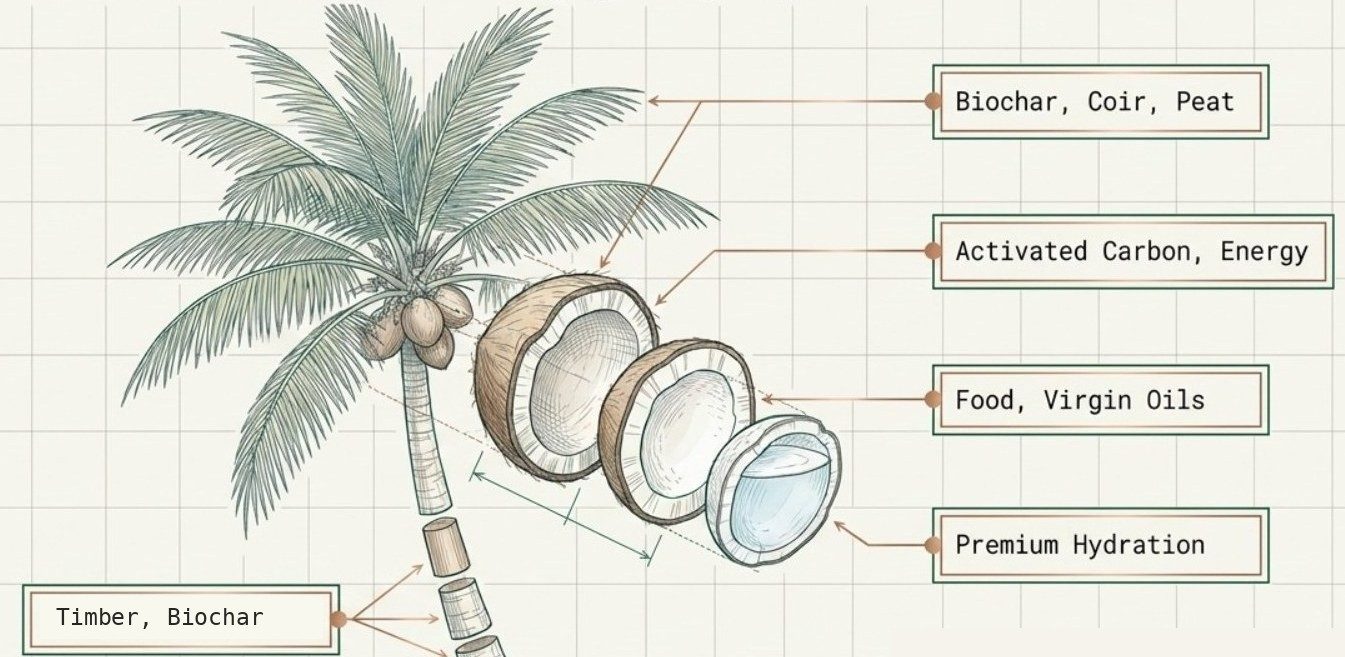
Nothing in the nut is wasted.
The commodity trade buys one part of the nut and leaves the rest on the ground. A rebuilt hectare sells all four, and the trunk too when an old palm is felled.
The land earns long before the new palms bear.
The four-year wait is what stops a smallholder replanting. The canopy closes that gap: it harvests in the first year and carries the land until the palms come in.
The standard is proof.
Indo Eden is built so that the buyer can check any batch, on any day, for himself.
Value is captured where it grows, and sold before it is harvested.
The same hectare can be sold at five levels. Each step up keeps more of the value on the land.
Demand is not the limit. Replanting speed is.
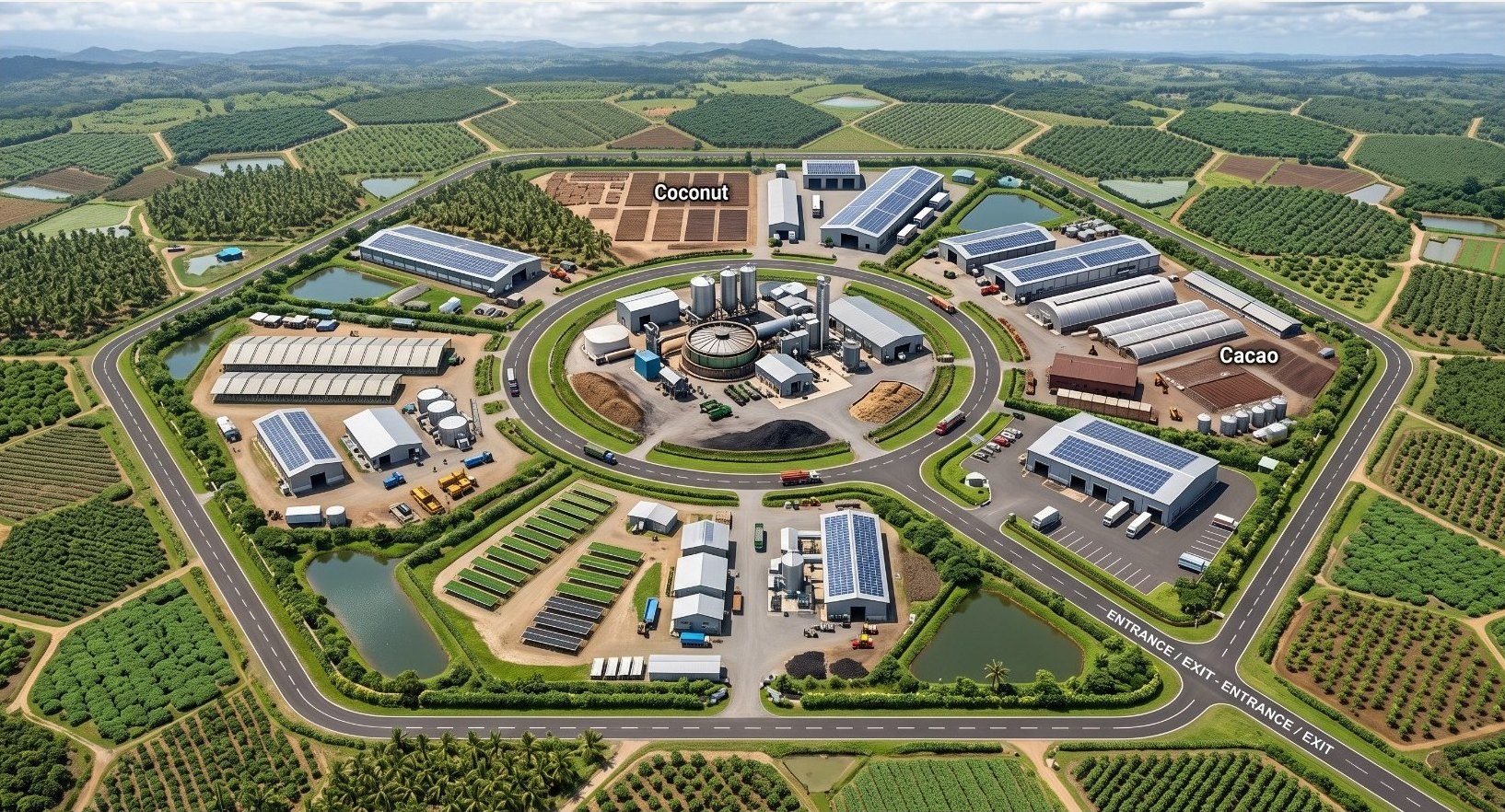
The world bought $1.42 billion of desiccated coconut in 2025, and the market grows about 10.5% a year. A rebuild of 1,500 hectares would supply about 1% of it. The constraint is how fast palms can go into the ground, which is the problem the buyer already has.